
By Junrel Real. Updated September 20, 2026.
If you’ve searched for your own cleaning business in ChatGPT and found nothing, that matters more than it did a year ago. In BrightLocal’s 2026 Local Consumer Review Survey of 1,002 US adults, 45% of consumers said they use ChatGPT and other generative AI tools for local recommendations, up from 6% the year before. Google (71%) and Facebook (68%) still rank ahead of AI, which is now the third most popular source.
AI engines don’t work from your website alone. In the Tampa study below, they also cited review sites, directories and listings that describe the businesses. GEO/AEO, Generative Engine Optimization and Answer Engine Optimization, is the practice of getting your business named in those AI-written answers. This article explains how it works, shows data from a Tampa house cleaning study I’m running at PH SEO Lab (96 of 180 planned runs completed as of September 19, 2026), and walks you through a ten-minute test you can run today.
The short answer
GEO/AEO, short for Generative Engine Optimization and Answer Engine Optimization, is the practice of getting your business named inside AI-written answers, not only ranked in Google Maps or the blue links. In the PH SEO Lab Tampa study (30 buyer questions across six AI engines, September 2026), MaidPro was recommended in 30 of 78 discovery and problem-first runs and Molly Maid in 24, while Royal Maid Service of Tampa, in business since 1992 by its own account, was recommended in none. Of the 121 source citations logged so far, 53 went to brand-owned sites, mostly the two franchises’ own, and 55 went to review sites and directories the businesses don’t own. The ten-minute test below shows where your own business stands.
What is GEO/AEO, and is it the same as geo-targeting?
Most business owners hear “GEO SEO” and assume it means geo-targeting, showing different content to people in different locations. It doesn’t. That’s a separate concept, and the naming overlap trips people up constantly.
GEO stands for Generative Engine Optimization. AEO stands for Answer Engine Optimization. The two terms describe the same goal, so this article uses GEO/AEO for both.
When someone asks ChatGPT or Perplexity a question, the engine writes an answer. Sometimes it names specific businesses. Sometimes it recommends one. Sometimes it lists your own website as a source. Those three outcomes are called mentioned, recommended and cited, and each points to a different problem.
| Signal | What it means | If you’re missing it, look at |
|---|---|---|
| Mentioned | Your business name appears anywhere in the answer | Whether the engine knows you and links you to the category. Start with the sources that describe you. |
| Recommended | The engine puts your business forward as a pick | If you’re mentioned but not recommended, the engine knows you and doesn’t rate you. Look at reviews and proof. |
| Cited | One of your own web pages is listed as a source | If you’re recommended but not cited, the engine is describing you with someone else’s page. Find out which page. |
| Aspect | Traditional local SEO | GEO for local businesses |
|---|---|---|
| Goal | Rank in Google Maps or search results | Get named inside an AI-generated answer |
| What success looks like | A map pin or blue link | Your business named in a sentence |
| What the engine reads | Your website, your Google Business Profile, your backlinks | Every source that mentions you online |
| What the user does | Clicks through to your site | May act on the answer without opening any site |
| What you optimize | Keywords, reviews, and consistent name, address and phone (NAP) | How clearly sources describe you |
Traditional local SEO works on your own website and profiles. GEO also works on the other sources that describe your business: Yelp, Angi, your BBB profile, local roundup sites, and reviews on platforms you don’t own.
Where do AI engines get their answers about local businesses?
You can have reviews, a fast website and a complete Google Business Profile and still not appear when someone asks ChatGPT for a cleaner. To see where the engines look, I logged every source they listed under each answer.
As of September 19, 2026, that log holds 121 source citations across the 96 runs completed so far, out of 180 planned. A source citation counts any page an engine listed, whoever owns it. That is different from the “cited” signal above, which counts only your own pages.
| Source type | Citations | Share |
|---|---|---|
| Brand-owned sites | 53 | 44% |
| Review platforms | 45 | 37% |
| Directories and listings | 10 | 8% |
| Government and institutional (BBB) | 5 | 4% |
| Forums and communities | 3 | 2% |
| Social profiles | 3 | 2% |
| Industry publication and other | 2 | 2% |
| Total | 121 | 100% |
Two domains account for most of the brand-owned share: mollymaid.com (20 citations) and maidpro.com (17). The 55 citations to review sites and directories came from pages such as exsplore.com, thebestflorida.com and angi.com. Six roundup and ranking sites (exsplore.com, thebestflorida.com, profindr.com, threebestrated.com, expertise.com and cityvetted.com) carried 30 citations between them. In the PH SEO Lab audit of Royal Maid, the business was absent from all six.
The chart below counts something different from source citations: how often each brand was named (mentioned) and how often it was put forward as a pick (recommended).
The one time an engine recommended Royal Maid, ChatGPT built its answer from bbb.org, birdeye.com and angi.com (Prompt 15, September 11, 2026). Royal Maid’s own site was not among the sources. When the fullest description of your business sits on a page you don’t own, that page can be the one an engine quotes, and improving your own site is only part of the work.
Why did one Tampa cleaner vanish on discovery questions and show up on a tenure question?
In September 2026, I started a 180-run study (30 buyer questions across six engines) of five Tampa house cleaning brands: Molly Maid, MaidPro, Royal Maid Service, Major Maids and Superb Maids. I’ve completed 96 runs so far. The six engines are ChatGPT, Perplexity, Claude, Microsoft Copilot, Google AI Overviews and Gemini.
The first 78 runs used discovery and problem-solving prompts, such as “Who are the best house cleaning companies in Tampa?” and “I need house cleaning urgently in Tampa this weekend, who’s available?” Royal Maid did not appear in any of them. It was not mentioned, not recommended and not cited.
Then I ran Prompt 30: “Which house cleaning companies in Tampa have been around the longest?” ChatGPT listed Royal Maid Service Tampa first in its table and described it as “Dedicated residential house/maid cleaning; one of the oldest Tampa-area specialists I found.” Perplexity also named Royal Maid and cited royalmaidtampa.com. Only two of the six engines mentioned Royal Maid on this prompt.
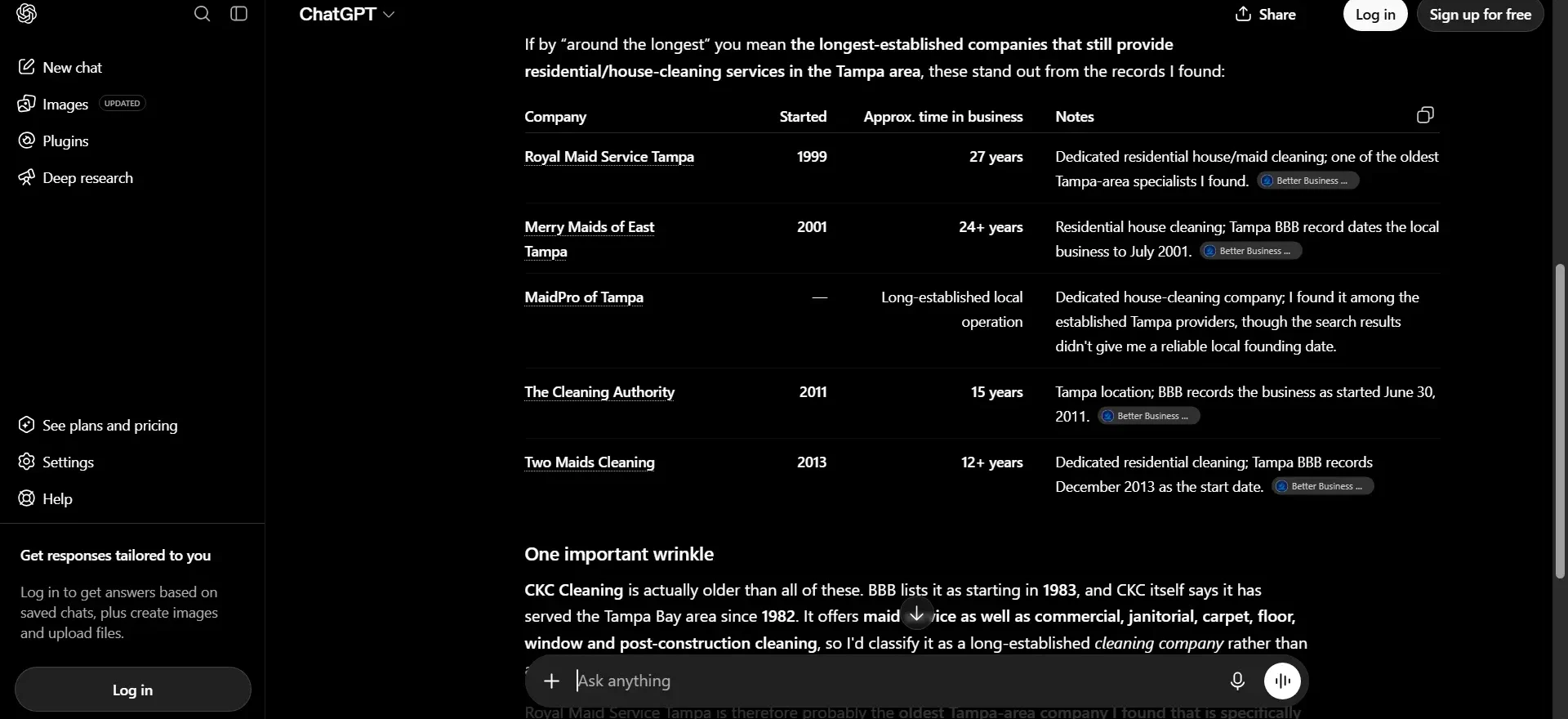
The two engines gave two different founding years. ChatGPT put Royal Maid’s start at 1999, or 27 years, and cited the Better Business Bureau. The BBB profile says “Business Started: 6/30/1999” and “Years in Business: 27” (viewed September 20, 2026). Perplexity said 1992, or 34 years, cited Royal Maid’s own site, and described the business as locally owned and operated since 1992.
Neither engine misread its source. The two sources disagree with each other. That’s what inconsistent business information looks like from the outside: two engines, two founding years, each quoting a page faithfully. It’s a small fact, but the same thing can happen to an address, a phone number or a service you don’t offer.
What changed between the discovery runs and Prompt 30 was the question.
Asked for the best cleaner in Tampa, the engines cited franchise sites and review roundups. Asked about tenure, ChatGPT went to a BBB profile and Perplexity went to Royal Maid’s own site. Two kinds of question drew from different sources. That’s one prompt, so I’m treating it as an observation to test, not a rule.
Royal Maid’s other mentions need context. Six of its eight came from Prompt 15, “Is Royal Maid Service a good house cleaning company?”, which names the business in the question, so they say little about discovery. For most cleaning businesses, the questions that bring in paying customers are discovery questions like “who’s the best cleaner near me?” Those were the runs where Royal Maid never appeared. That’s the gap worth closing.
How can I test my own AI visibility in ten minutes?
Before you pay anyone to fix your AI visibility, find out where you stand. This takes about ten minutes and needs no tools or technical knowledge. It’s worth the time: in BrightLocal’s 2026 survey, 40% of consumers said they trust AI platforms for business recommendations.
The ten-minute self-test
The quickest way to run this is PH SEO Lab’s free AI Self-Check. It puts the questions to the assistants one screen at a time, records what each one says, and hands you your own counts at the end. About ten minutes, nothing to install, no email required.
Or do it by hand. Open ChatGPT and Perplexity in separate tabs. Sign out of both, or use an incognito window. A signed-in account personalizes results. You want to see what a stranger sees.
Run these three queries in each engine, typed exactly as written:
- Best house cleaning service in [your city]
- Who should I hire to clean my home in [your city]?
- Most trusted cleaning company in [your city]
For each answer, note three things. Mentioned: does your business name appear anywhere in the answer? Recommended: is your business put forward as a pick, or just named in passing? Cited: does the engine link to your own website as a source?
AI answers vary from run to run, so run each query two or three times before you trust a result. If your business doesn’t appear across six queries on two engines, take that seriously.
Also note which businesses do appear. If a direct competitor shows up and you don’t, the gap is active. If nobody in your niche appears, you’re early to this rather than behind.
Write down what you find. That record becomes your baseline, and without it any future improvement is unverifiable.
Should you pay to fix this now, or wait?
Two checks come first because both are free and either can keep you out of an engine entirely. Your test results then tell you whether you have a gap.
Check first
Your business is blocked from AI crawlers.
AI engines use their own crawlers to read the web. OpenAI says “OAI-SearchBot is for search” and is “used to surface websites in search results in ChatGPT’s search features.” Perplexity says “PerplexityBot is designed to surface and link websites in search results on Perplexity.” Anthropic says “Claude-SearchBot navigates the web to improve search result quality for users.” Open yourdomain.com/robots.txt and check whether any of the three is blocked. Allowing them costs nothing. GPTBot is a separate OpenAI crawler for model training, so blocking it is a different decision. Google works differently: for AI Overviews and AI Mode, Google says a page “must be indexed and eligible to be shown in Google Search with a snippet.”
Check first
Your business information is inconsistent across platforms.
In the Tampa study, ChatGPT reported that Royal Maid started in 1999 and Perplexity reported 1992, because the BBB profile and Royal Maid’s own site disagree. If your name, address, phone number or service description reads differently on Yelp, Angi, your BBB profile, your Google Business Profile and your website, each engine may repeat a different version. Checking this costs time, not money.
Act now
A competitor is already showing up on your discovery queries.
If your self-test showed a direct competitor recommended on queries like “best cleaning service in [your city],” that is the gap to look at first. In the Tampa study, MaidPro was recommended in 30 of 78 discovery and problem-first runs and Molly Maid in 24. Royal Maid was recommended in none. This is the situation where an AI visibility implementation is worth pricing out.
Wait
Nobody in your niche is showing up yet.
If your self-test showed no cleaning businesses being recommended at all, you may not be behind. Set a reminder to re-run the test in about 90 days, which is my own rule of thumb and not a published standard. AI answers change often, so the picture may look different by then.
Frequently asked questions
Does being visible in ChatGPT replace my Google ranking?
No. They serve different moments. Google rankings bring people to your website when they’re actively searching. AI recommendations appear when someone asks a broader question and wants a direct answer. In BrightLocal’s 2026 survey, 71% of consumers used Google for local recommendations and 45% used ChatGPT or other generative AI tools, so a cleaning business benefits from both.
Can I do GEO/AEO myself, or do I need to hire someone?
Partly. Two checks cost nothing and you can do them yourself: whether your robots.txt blocks AI search crawlers, and whether your business information matches across platforms. Finding which sources the engines read for your category, and building presence on them, takes more time and structure. In the Tampa study, six roundup and ranking sites carried 30 of the 121 source citations. The free AI Self-Check from PH SEO Lab shows which situation you’re in before you spend anything.
How do I know if GEO/AEO is actually working?
Re-run the same self-check in the same engines, signed out, about 90 days later, and record the results the same way. AI answers vary, so look for your business appearing more consistently, not for a single change. Check one competitor you did nothing about at the same time as a control. If it moved as much as you did, the movement may not be yours. Comparing two baselines tells you far more than checking once.
What the Tampa study does and does not show
The study covers five brands, one city and one service, so it isn’t a verdict on every local business. It does show a pattern worth testing in your own market. MaidPro and Molly Maid, whose own websites were the two most-cited domains, were recommended most. Royal Maid, in business since 1992 by its own account, was recommended in none of 78 discovery and problem-first runs, and its one recommendation came from an answer built on BBB, Birdeye and Angi pages. The audience is already there: 45% of consumers in BrightLocal’s 2026 survey use generative AI for local recommendations, up from 6% a year earlier. Start with a ten-minute test and a notes document.

Junrel Real
Runs PH SEO Lab from Taguig City, Philippines, working with service businesses across the United States. Every visibility measurement runs 30 buyer questions across six AI engines for 180 recorded answers. More about how I work
Find out where you actually stand
The AI Self-Check runs the test above for you in about ten minutes and gives you your own counts to keep. Free, nothing to install.
Run the free AI Self-Check